Learn why jumping rope develops the deep core muscles every runner needs.
When you step into your workout routine six days a week, you quickly learn that the body doesn't work in isolated compartments. Many folks walk into the gym fixated on getting visible six-pack abs, but the real story lives deeper. Your core encompasses far more than the rectus abdominis that makes for Instagram photos. It includes the transversus abdominis, iliopsoas and diaphragm working as your body's natural corset, stabilizing your spine and posture through every movement. The quadratus lumborum, multifidus and rotator cuff form the other major group, enabling you to sit tall, twist, bend and carry out exercises with proper mechanics.
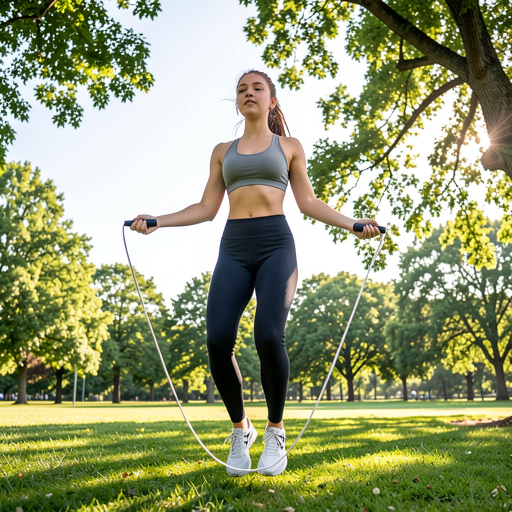
Understanding this distinction changes how you train, because you stop chasing surface muscles and start building the foundation that supports everything else. This is where a simple rope changes everything. Jumping rope forces your entire core into action without any machines or complicated setups. Each bounce demands that your stabilizing muscles fire continuously to keep your torso upright and your balance locked in. You might start with basic two-foot jumps, but as your stamina builds and you introduce more complex footwork, your transversus abdominis and diropaghm engage harder than you ever expected.
🧠
The rhythm of jumping rope teaches your body to move efficiently across multiple planes simultaneously, which is exactly what running demands. Athletes who incorporate skipping into their training often notice better posture, improved balance and a more resilient midsection without doing a single crunch. Running takes this principle and pushes it further. Every stride sends force through your legs and up into your pelvis, where your core muscles scramble to keep your torso stable and your alignment clean. You are moving through the sagittal, frontal and transverse planes all at once and your core connects it all.
🤳🏻
When those deep stabilizers get strong, your pelvis stays level, your stride stays efficient and your legs can do their job without compensating for a weak center. This matters just as much for casual joggers as for marathon runners, because a tired core means a breakdown in form and an increased risk of injury. Learning to skip regularly builds the endurance these muscles need, giving you the stability to sustain good mechanics even when fatigue sets in. The practical takeaway is straightforward: stop treating your core as an afterthought and start training it as the engine it truly is. You do not need expensive cable machines or dozens of different ab exercises.
🤸️
A consistent schedule that includes skipping, bodyweight movements like planks and dead bugs and proper running technique will develop the strength and endurance you actually need. Start by setting aside a minimum of one hour most days, mixing in core-focused work and rope sessions two or three times per week. Your body will thank you with better posture, more powerful strides and a midsection that supports every activity you throw at it. The muscles that keep you upright and moving well are always there, waiting for you to engage them properly.